“The Ambassadors” by Hans Holbein is a fascinating place to start our study of Latin found in famous works of art. This beautifully executed work, rich in symbolism, contains the same Latin phrase repeated twice: aetatis suae, followed by the numbers ’25’ and ’29’ respectively.

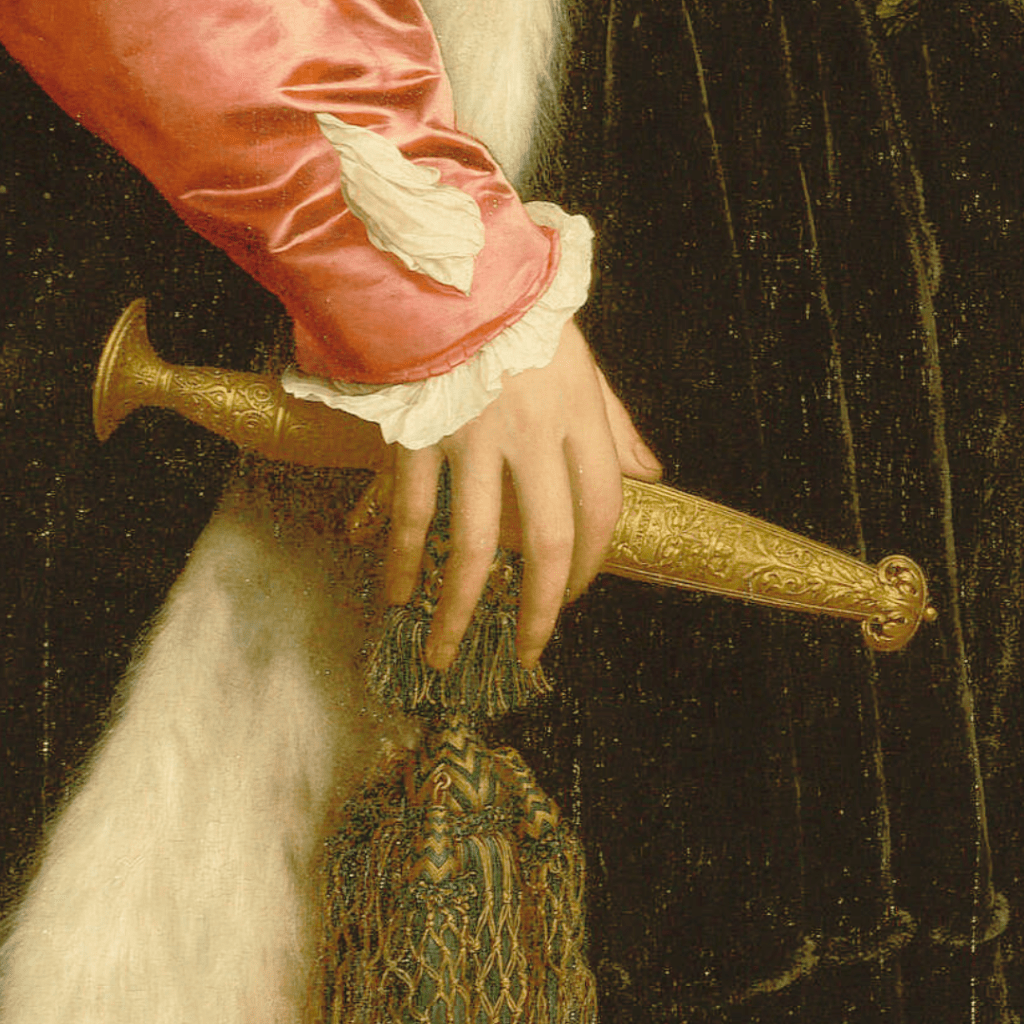
Aetatis suae.25 is found written on a book lying on the table while aetatis suae.29 is inscribed on the scabbard. This one is extremely tiny, and can just be made it out to the right of the figure’s index finger.
Aetatis is the genitive singular form of aetis, meaning ‘age’ or ‘generation’, ‘period’ or ‘time’.
suae is a possessive pronoun (although it is feminine, for some reason) and the phrases are usually translated as ‘his 25th year’ and ‘his 29th year.’ These refer to the ages of the two men in the painting.
The distorted object at the bottom of the painting is what attracts usually the attention of viewers: it is a human skull drawn at an angle. This also has a Latin connection, as memento mori (remember that you must die) is a theme of the painting. A partially-hidden crucifix in the upper left corner of the painting continues this theme.
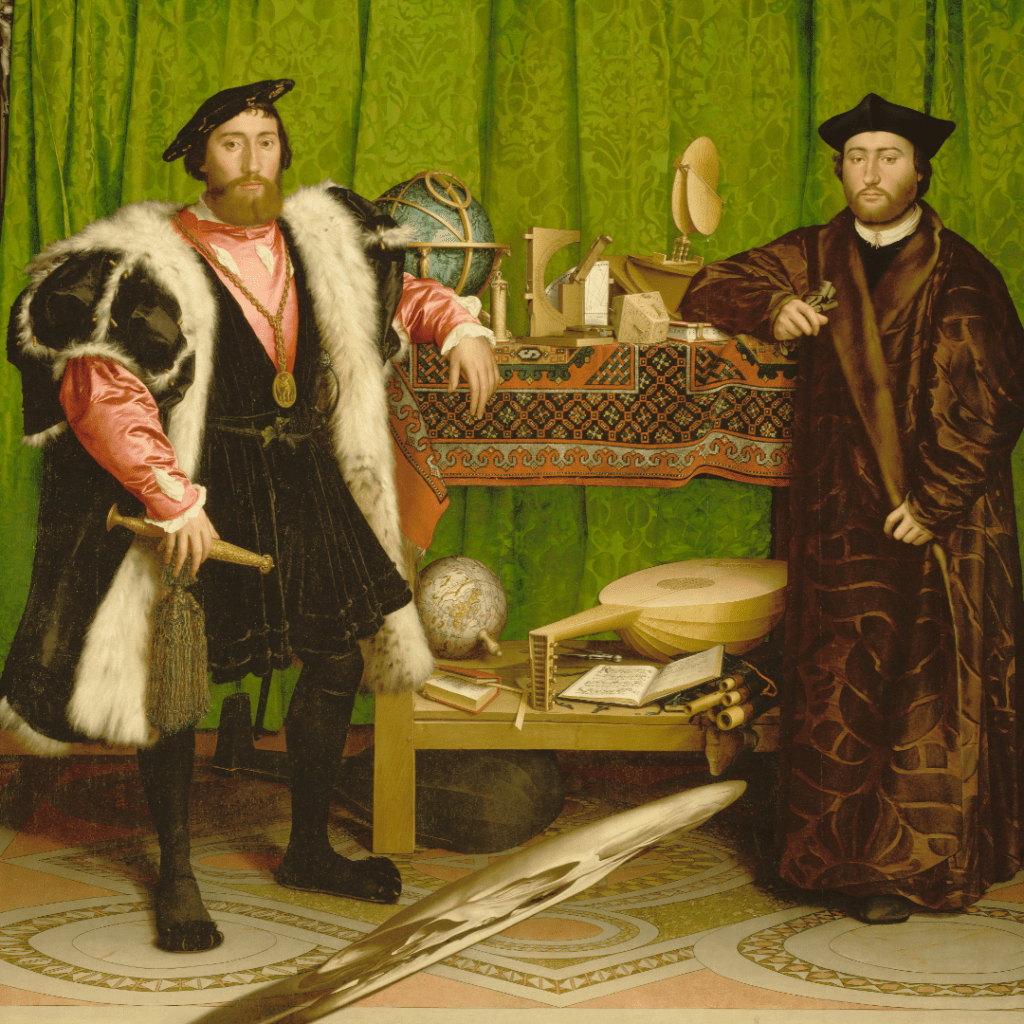
The two men are Jean de Dinteville on the left and Georges de Selve to the right. De Dinteville was a French ambassador to the court of Henry VIII, and de Selve was Bishop of Lavaur. As De Selve had not yet been consecrated, he is not shown in his episcopal vestments.
It is said that at the time this was painted, Holbein, a German, was visiting England, painting portraits of Henry VIII’s courtiers. Henry VIII was then breaking with Rome, causing a huge upheaval. De Dinteville was tasked with negotiating with Henry, something he did not relish, but was cheered up by the arrival of his friend, de Selve and commissioned this portrait.

 Ora et Labora
Leave a comment