Latin Marian Prayer for October
Since October is traditionally known as the month of the Holy Rosary, it might be helpful to add a new Marian prayer to your repertoire that may be prayed in Latin or in English.
(If you’d like a free download of this prayer in Latin, then please go to my shop)
History of the Sub Tuum Praesidium
The Sub Tuum Praesidium is thought to be the oldest Marian prayer, with a 3rd century papyrus version still in existence. While that version is in Greek; the Latin version found below dates from the 11th century. It is still used today in the Roman liturgy as well as in the Coptic, Byzantine, and Ambrosian liturgies.
As can be seen, there are similarities between this prayer and the Memorare, which was written in the 16th century.
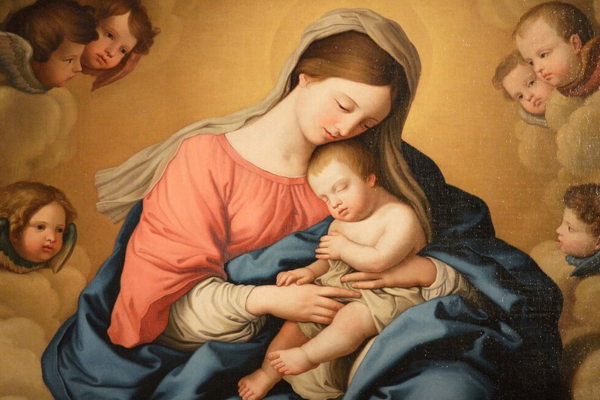
Sub Tuum Praesidium in Latin
Sub tuum praesidium confugimus,
Sancta Dei Genetrix.
Nostras deprecationes ne despicias in necessitatibus,
sed a periculis cunctis libera nos semper,
Virgo gloriosa et benedicta.
Sub Tuum Praesidium in English
We fly to thy protection,
O holy Mother of God.
Despise not our petitions in our necessities,
but deliver us always from all dangers,
O glorious and blessed Virgin.
Notes on the Latin
When the prayer was made into a sung antiphon, it was put to an existing piece of music. This resulted in some slight changes in the text and its meaning.
Semper, always, now incorrectly modifies libera nos, free us, but it was originally meant to modify Virgo in order to acknowledge Our Lady’s perpetual virginity. The version below is more true to the original Greek:
Under your protection we take refuge,
Oh Holy Mother of God.
Do not despise our petitions in our necessities,
but deliver us from all dangers,
Oh Always Virgin, Glorious and Blessed.
(This additional information comes from Dappled Things, where the author has made quite a study of this ancient prayer.)
For a free download of this prayer in Latin, then please go to my shop.
Sub Tuum Praesidium Chant
A beautiful chanted version of the prayer can be found below
SOURCES: Knights of the Holy Eucharist website; Preces Latinae website, Church Pop; John 1010 website. IMAGE SOURCE: Giovanni Battista Salvi da Sassoferrato, Public domain, via Wikimedia Commons


 Ora et Labora
Leave a comment